Share links
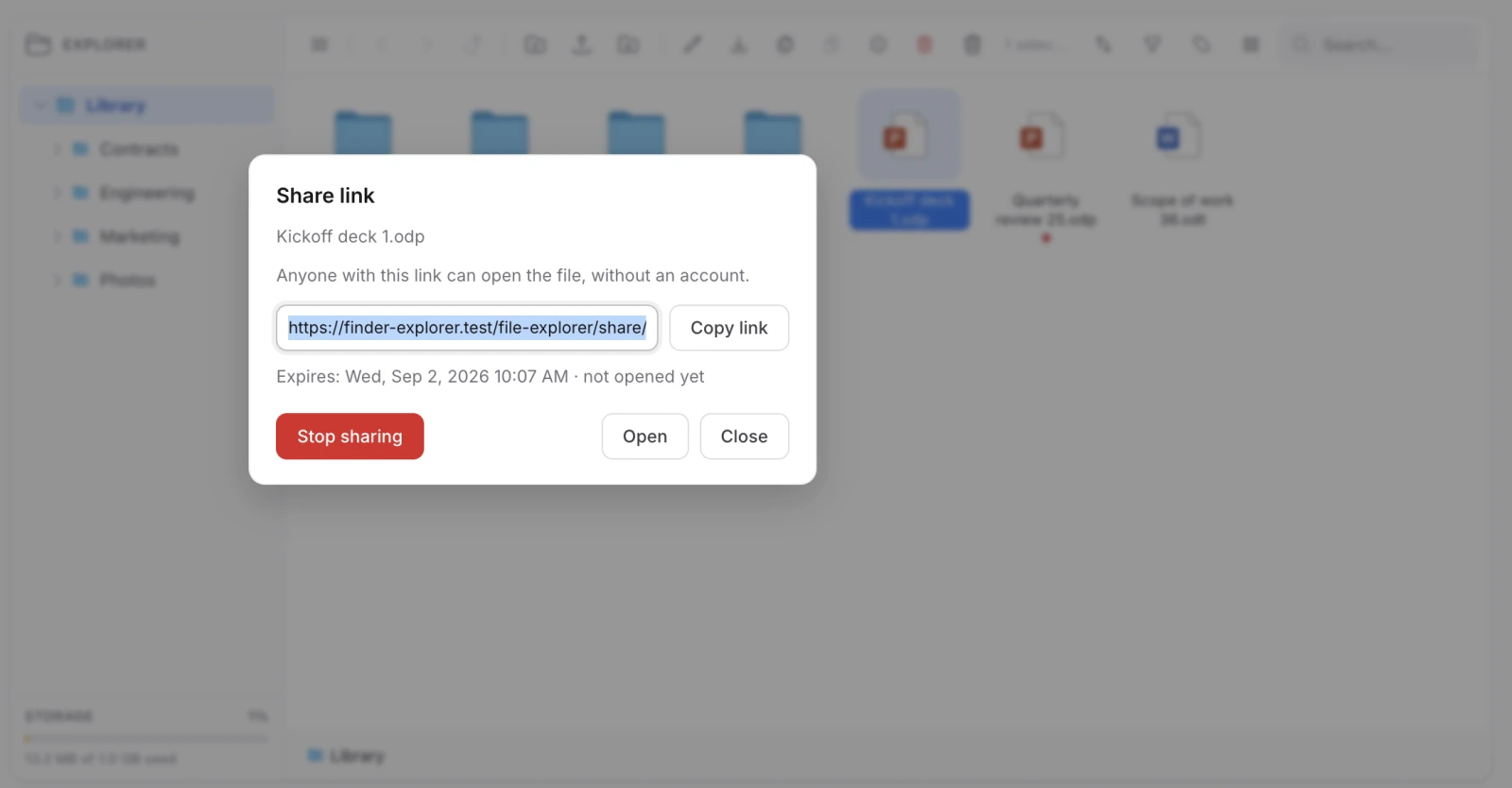
Right-click a file and Share gives it a link that works with no account and no session — which is the point: it is how you send a file to someone outside the panel. The dialog shows the link, when it expires, how many times it has been opened, and a button to stop sharing.
// config/filament-file-explorer.php
'share' => [
    'enabled' => true,
    'table' => 'file_explorer_shares',
    'default_ttl_days' => 7,
    'max_ttl_days' => 30,   // a ceiling, not a default; null allows links that never expire
],
max_ttl_days is a ceiling: a caller asking for longer, or for no expiry, gets the ceiling. Set it to null to allow links that never expire, and default_ttl_days to null to make that the default.
Gated on the share ability, which follows download for any authorizer that does not answer it — so an authorizer written before this existed keeps meaning what its author meant, and one that refuses downloads refuses sharing too.
How it holds up without a session
This is the only route in the package with no authenticated user behind it, so the two guards cannot both run at request time. They are split in time:
- The ability is checked when the link is made, and that decision is what the row records. There is nobody to ask afterwards.
- Containment is checked on every request, against the root folder stored on the row — never against anything derived from the media, which would only prove the file sits under its own ancestor.
That split is what makes a link die on its own, with nothing to keep in step:
| The file is | The link |
|---|---|
| moved out of the scope it was shared from | fails the containment walk |
| trashed | leaves the explorer’s collection and fails the same check |
| deleted | has no row |
Nothing keeps a share in step with the tree, because nothing has to.
The route
It takes the token and nothing else — no scope key, no media id, no conversion name — so a link cannot be edited into a link for another file or another rendition.
A bad token, an expired one, a revoked one and a file that has gone all answer 404 alike. Telling them apart would say whether a token was ever real.
Middleware is ['web'], deliberately without auth: a link that needed an account would not be a share.
Revoking
Links are stored rather than signed, because revoking is the half of sharing that matters. A signed link cannot be withdrawn without a revocation list, which is a stored row with extra steps.
Revoking is a database write and takes effect immediately. The row is kept, so a withdrawn share is still there to inspect.
Sharing the same file twice hands back the existing link rather than minting a second, so revoking has one thing to revoke — and FileShared therefore fires only for a link that is actually new.
Events
FileShared |
media, share — only for a link that did not already exist |
ShareRevoked |
share |
Reading it yourself
use Koassi\FilamentFileExplorer\Support\Sharing;

$sharing = app(Sharing::class);

$share = $sharing->resolve($token);              // null for a bad, expired or revoked token
$media = $share ? $sharing->mediaFor($share) : null;   // null when containment fails

$sharing->activeForMedia($media->id, $scopeKey, $rootFolderId);
$sharing->url($share);
$sharing->revoke($share);
resolve() is the token half and mediaFor() the containment half — the same two calls the controller makes, so a link you validate in your own code and a link the route serves cannot disagree.